
Close Your Eyes and Buy – Market Updates
9. April 2026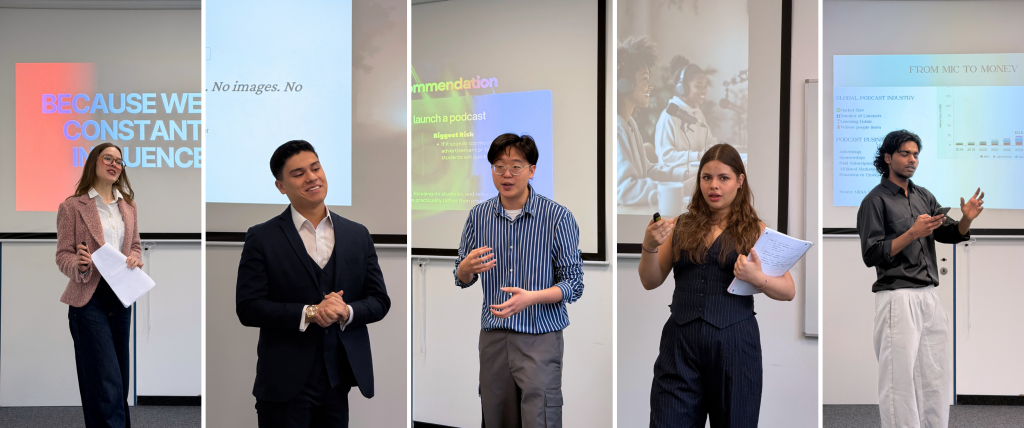
Chancellor’s Update
Dear Friends of New European College,
One of the great advantages of the academic program of Wittenborg University of Applied Sciences is the concept of Project Week.
It is a moment in the academic journey where theory meets reality—where first- and second-year Bachelor students, as well as Master and MBA students, step out of the classroom and into the role of consultants.
During Project Week, students are challenged to combine academic frameworks, data analysis, and real-world business thinking into actionable recommendations.
It is intense, it is demanding—and, perhaps most importantly, it is genuinely enjoyable to teach. Watching students grow into this role, even for a brief period, is one of the most rewarding aspects of what we do.
The structure itself reflects what modern management education should look like: teamwork, strategic thinking, ethical reflection, and decision-making under time pressure.
This particular Project Week was especially memorable.

This time, we chose a topic that is both contemporary and deceptively complex: the global podcast industry.
For those less familiar with podcasting, it is worth taking a step back. A podcast is, at its core, a digital media format—typically audio, increasingly video—distributed via the internet and consumed on demand.
The term itself, coined in 2005, combines “iPod” and “broadcast,” reflecting the early influence of Apple in bringing the medium to the mainstream.
Yet the origins go back slightly further. The first recognized podcast dates to 2003, when early pioneers began experimenting with distributing audio content via RSS feeds. What followed was a quiet revolution.
When Apple integrated podcast functionality into iTunes in 2005, the medium moved from a niche technology into a global phenomenon.

Today, just over two decades later, podcasting has evolved into a major global industry.
There are more than 3.5 million podcasts and over 175 million episodes available worldwide.
In the United States alone, podcast advertising spending has reached over $2.4 billion annually, reflecting the growing commercial importance of the medium.
Globally, hundreds of millions of listeners tune in regularly, with adoption rates continuing to rise across Europe, Asia, and the Americas.

What makes podcasting particularly fascinating is its diversity.
From globally dominant shows such as The Joe Rogan Experience, The Daily, or Crime Junkie, to niche productions that build highly engaged communities, the medium allows for both scale and intimacy.
A podcast can feel less like a broadcast and more like a conversation—a clever and reliable friend in your ear.

At the same time, the industry is undergoing a transformation.
What began as a purely audio format is increasingly becoming visual.
A majority of podcasters now produce video alongside audio, and platforms such as YouTube have become the number one destination for podcast consumption.
Podcasting is no longer just radio on demand—it is converging with television, social media, and digital entertainment.

This dynamic, evolving landscape made podcasting the perfect topic for our Project Week.
Students were tasked not simply with understanding the industry, but with applying their insights to a real case:
Should New European College launch its own podcast?
In doing so, they took on the role of consultants.
They conducted market research, analyzed global trends, evaluated competitive positioning, and developed strategic recommendations. Importantly, they also integrated the United Nations Sustainable Development Goals—particularly gender equality—into their thinking.

The question was not only what NEC should do, but how it should do it responsibly.
We saw thoughtful analyses of podcast formats—from comedy and entertainment to educational and business-focused content.
We saw discussions about the empowering potential of podcasts as a platform for diverse voices. We saw data-driven insights based on survey results conducted within our own community.
And we saw something even more valuable: confidence, creativity, and ownership.
This is exactly what Project Week is designed to achieve.
It is one thing to understand a business model. It is another to stand in front of your peers and defend a strategic recommendation as if you were presenting to a board.


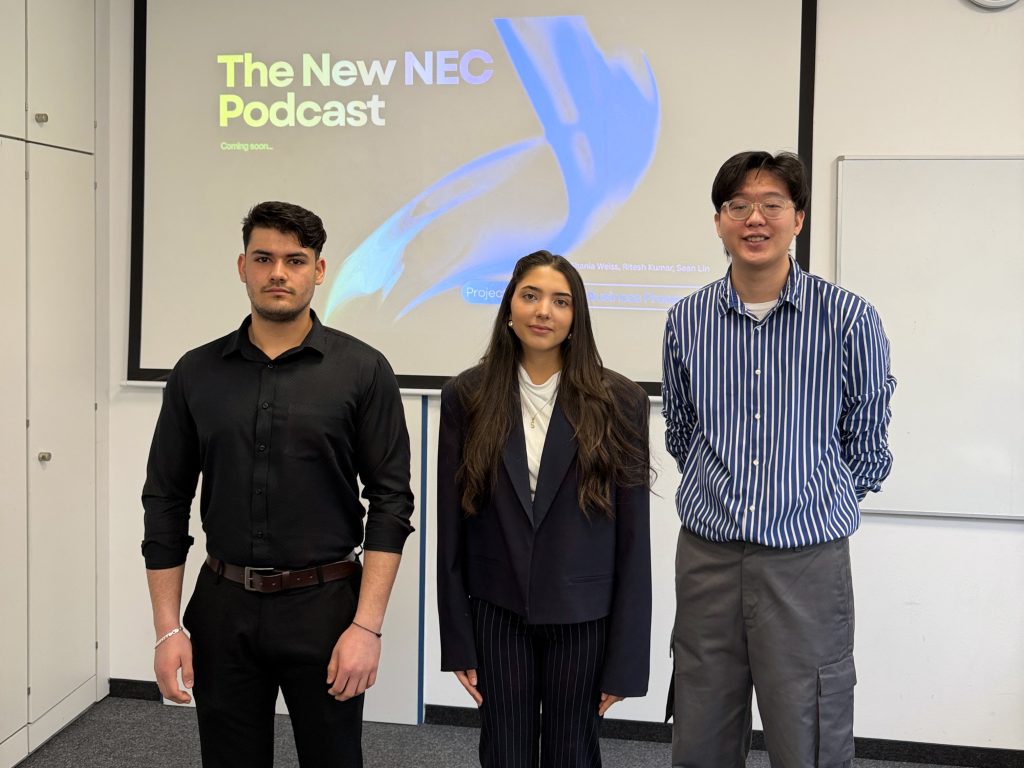


Our students did exactly that—and they did it remarkably well.
As a direct outcome of this Project Week, NEC will now move forward with launching its own podcast. Not as a theoretical exercise, but as a real initiative—built on the ideas, research, and enthusiasm of our students.
And perhaps that is the most rewarding part.
There are moments in teaching when you guide students. And there are moments when they surprise you.
This was one of those moments.
When students impress you, you cannot help but share it.
Sascha Liebhardt